Home » Fact Library » Space Facts
🚀 Space Facts
Space is where Frank's usual "you won't believe this" runs out of road, because up there the true numbers are already past believing. Forty-three verified facts follow — planets that spin backward, a day that outlasts a year, a spoonful of star that would outweigh a mountain, and the pocket-sized computer that steered humans to the Moon. Every figure here is credited or carefully hedged, because in astronomy the honest number is astonishing enough.
Planets Behaving Strangely
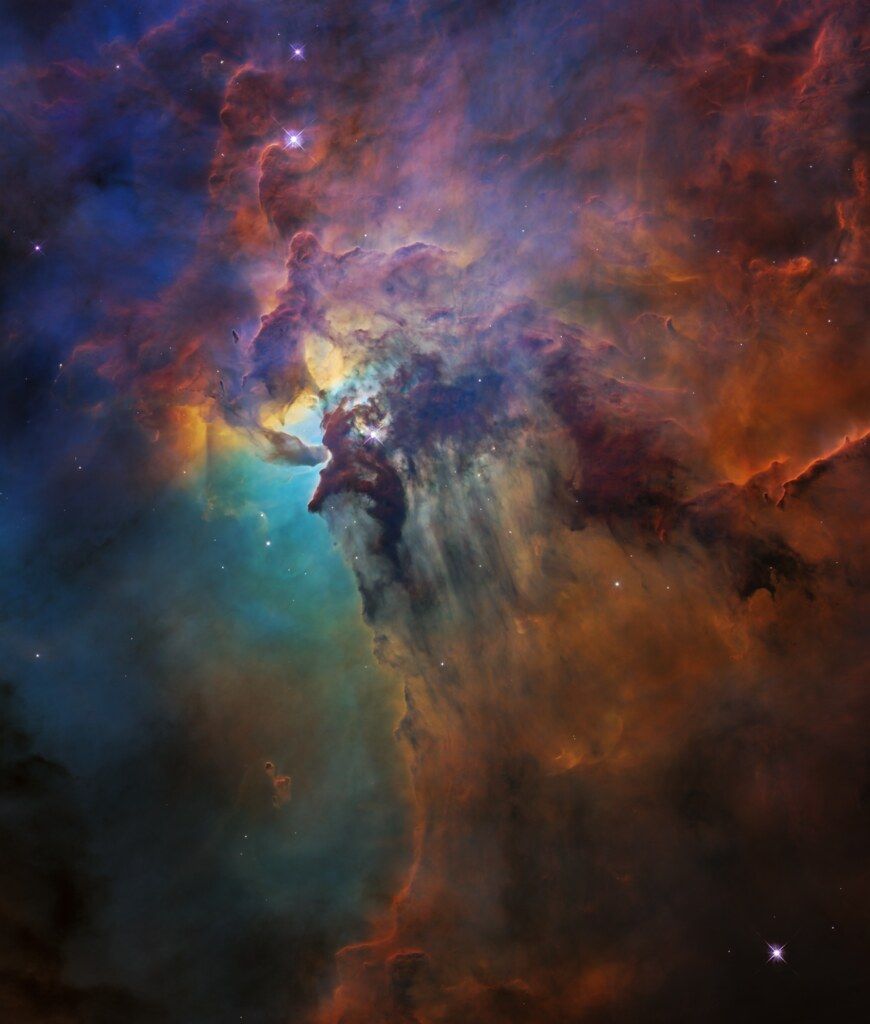
- FACT #200 A day on Venus is longer than its year. Venus turns on its axis so slowly that one full rotation takes about 243 Earth days, while a trip around the Sun takes only about 225. The clock outlasts the calendar. (according to NASA)
- FACT #201 Venus also spins backwards compared with most planets, so on Venus the Sun would rise in the west and set in the east — if you could see it through the thick clouds at all.
- FACT #202 Venus is the hottest planet in the Solar System, hotter even than Mercury, which sits closer to the Sun. Its dense carbon-dioxide atmosphere traps heat so effectively that surface temperatures top 460 degrees Celsius — hot enough to melt lead. (according to NASA)
- FACT #203 Mercury, despite being nearest the Sun, has water ice. Deep craters near its poles never see sunlight, and radar and NASA's MESSENGER mission found evidence of ice hiding in that permanent shadow.
- FACT #204 Jupiter's Great Red Spot is a storm larger than the entire Earth that has raged for centuries — astronomers have been watching it for well over 150 years, and it may have been churning far longer.
- FACT #205 Saturn is less dense than water. If you had a bathtub big enough, the whole planet would float — it's a giant ball of mostly hydrogen and helium, lighter for its size than the liquid in your kitchen. (according to NASA)
- FACT #206 Both Uranus and Neptune are thought to have interiors where extreme pressure could turn carbon into diamond — leading scientists to speculate about "diamond rain" falling through their deep atmospheres.
- FACT #207 Uranus rolls around the Sun on its side, tipped over at nearly a right angle, likely knocked askew by an ancient collision. Its poles, not its equator, take turns pointing at the Sun.
- FACT #208 Mars is home to Olympus Mons, the tallest known volcano in the Solar System — roughly two and a half times the height of Mount Everest above sea level, and about as wide as the state of Arizona. (according to NASA)
- FACT #209 Mars has the largest dust storms in the Solar System, occasionally growing to blanket the entire planet for weeks — one of them helped end NASA's Opportunity rover mission in 2018.
- FACT #210 A year on Neptune lasts about 165 Earth years. Since its discovery in 1846, Neptune completed its very first full orbit as observed by humanity only in 2011.
- FACT #211 The Solar System's planets could all fit, side by side, in the average gap between the Earth and the Moon — the distances involved are that large, and the planets, relatively, that small.
Moons & Small Worlds
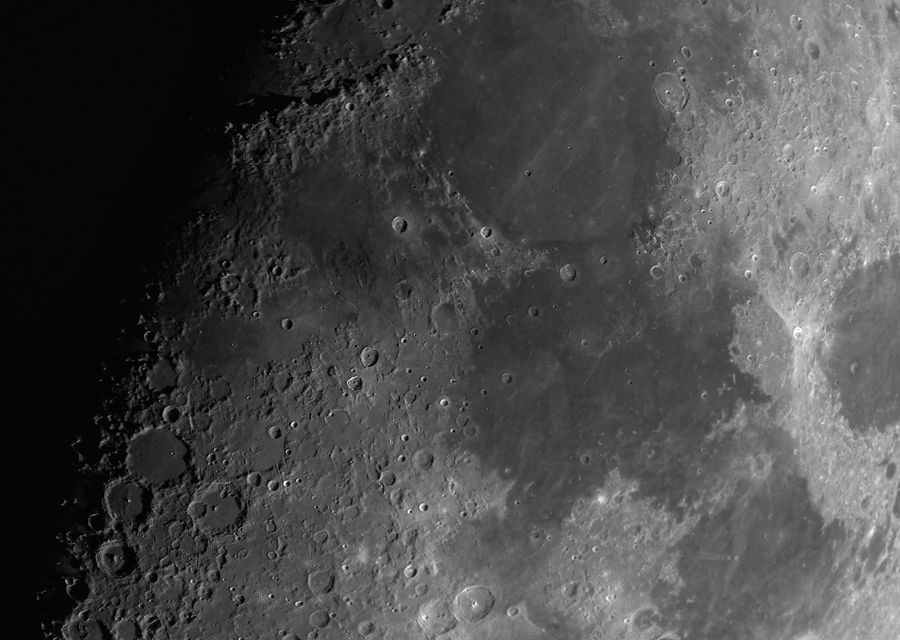
- FACT #212 The Moon is drifting away from Earth by roughly 3.8 centimeters a year — about the rate your fingernails grow — measured precisely using reflectors left on the surface by the Apollo astronauts.
- FACT #213 The same side of the Moon always faces Earth. Its rotation is "tidally locked" to its orbit, which is why the far side stayed a mystery until a Soviet spacecraft photographed it in 1959.
- FACT #214 Footprints left by the Apollo astronauts are likely still there, crisp as the day they were made. With no wind and no rain on the Moon, only a stray micrometeorite or future visitor is likely to disturb them.
- FACT #215 Jupiter's moon Europa hides a global ocean of liquid water beneath its icy crust — possibly containing more water than all of Earth's oceans combined — making it a prime place to search for life.
- FACT #216 Saturn's moon Titan has rivers, lakes, and rain — but of liquid methane and ethane, not water. It's the only world besides Earth known to have stable liquid on its surface today.
- FACT #217 Jupiter's moon Io is the most volcanically active body in the Solar System, its surface constantly repaved by hundreds of erupting volcanoes, driven by the gravitational kneading of Jupiter and neighboring moons.
- FACT #218 Pluto is smaller than Earth's Moon, and it's smaller across than the width of the United States. It was reclassified as a "dwarf planet" in 2006, a decision Frank still gets letters about.
- FACT #219 A comet's tail always points away from the Sun, pushed by the solar wind and sunlight — so as a comet swings around and heads back out, its tail leads the way rather than trailing behind.
- FACT #220 The asteroid belt between Mars and Jupiter is mostly empty space. Despite the movies, the asteroids are so widely scattered that spacecraft fly through without any special dodging.
"A neutron star is so dense that a single sugar-cube-sized piece of it would weigh, by common estimates, about as much as all of humanity put together — roughly a billion tons."
Frank says: don't try to pick one up. You would lose, and so would the sugar cube.
Stars & Deep Space
- FACT #221 A neutron star packs more mass than the Sun into a ball only about the size of a city — so dense that a teaspoon of its material would weigh in the billions of tons. These are the crushed cores left behind when massive stars explode.
- FACT #222 Our Sun accounts for about 99.8 percent of all the mass in the entire Solar System. Everything else — every planet, moon, asteroid, and comet — shares the remaining sliver.
- FACT #223 The Sun is so large that roughly a million Earths could fit inside it, and it converts millions of tons of matter into energy every second to keep shining.
- FACT #224 The nearest star beyond the Sun, Proxima Centauri, is about 4.2 light-years away — so far that its light takes over four years to reach us, and a spacecraft with today's technology would need tens of thousands of years to arrive.
- FACT #225 When you look at distant stars, you're looking back in time. The light left them years, centuries, or millennia ago — so the night sky is really a photograph of the past, with every star showing its old self.
- FACT #226 Betelgeuse, the red star on Orion's shoulder, is so enormous that if it replaced our Sun, its surface would likely engulf the orbits of the inner planets. It's a candidate to explode as a supernova — sometime in the next hundred thousand years or so.
- FACT #227 There are, by common scientific estimates, more stars in the observable universe than grains of sand on all the beaches of Earth. Frank has not counted either, but he trusts the astronomers.
- FACT #228 A supermassive black hole sits at the center of our Milky Way galaxy, named Sagittarius A*, with a mass millions of times that of the Sun. In 2022 astronomers released the first image of it.
- FACT #229 Space is not completely silent for the reason people think — there's no air to carry sound — but it is not perfectly empty either; even "empty" space holds a few atoms per cubic meter and a faint glow left over from the Big Bang.
- FACT #230 The observable universe is about 93 billion light-years across, even though it's only around 13.8 billion years old, because space itself has been stretching and expanding all that time.
- FACT #231 The Andromeda galaxy is on a collision course with our Milky Way, expected to begin merging in roughly four billion years. Because stars are so far apart, remarkably few are likely to actually collide.
✉️ Yes, Frank — Send Me the Free Weekly Facts!
Join the readers who win every trivia night.
One email every Friday. No spam, no nonsense, unsubscribe whenever you like. Frank's word is good.
Spaceflight History
- FACT #232 The Apollo Guidance Computer that helped land humans on the Moon had a tiny fraction of the memory and speed of a modern smartphone — its working memory was measured in kilobytes. As the joke goes, a musical greeting card carries more computing muscle today.
- FACT #233 On July 20, 1969, Neil Armstrong and Buzz Aldrin became the first humans to walk on the Moon, while Michael Collins orbited overhead in the command module. An estimated 600 million people watched on television.
- FACT #234 Sputnik 1, the first artificial satellite, launched in 1957 and was about the size of a beach ball, weighing roughly 83 kilograms. Its steady radio "beep" could be picked up by amateur radio operators around the world.
- FACT #235 Yuri Gagarin became the first human in space in April 1961, completing a single orbit of the Earth in under two hours before returning safely.
- FACT #236 Both Voyager 1 and Voyager 2, launched in 1977, have now left the region dominated by the Sun's wind and are traveling through interstellar space — the most distant human-made objects in existence. Each carries a golden record of Earth's sounds and images.
- FACT #237 The International Space Station orbits Earth roughly every 90 minutes, so its crew sees about 16 sunrises and 16 sunsets every single day.
- FACT #238 Astronauts can grow taller in space. Without gravity compressing the spine, the vertebral discs expand, and crew members have measured a few centimeters of temporary height gain — which reverses once they're back on the ground.
- FACT #239 The Hubble Space Telescope, launched in 1990, has traveled billions of miles while orbiting Earth and has helped astronomers pin down the age of the universe and photograph galaxies billions of light-years away.
- FACT #240 Space is a genuine vacuum, so spacecraft can't slow down using air brakes the way an airplane does; returning capsules instead use the atmosphere itself as a brake, generating fierce heat that a heat shield absorbs.
- FACT #241 The gold-tinted visors on astronauts' helmets contain a real, extremely thin layer of gold, which reflects harmful glare and radiation from the unfiltered Sun while still letting them see out.
- FACT #242 Twelve people have walked on the Moon, all between 1969 and 1972 during the Apollo program. No human has returned to the lunar surface since — though space agencies are working to change that.
That's forty-three facts and the sky's quite literally not the limit. If your brain needs to come back down to Earth, the History Facts shelf is right where you left it. And the very best space facts fly out first every Friday in Frank's Five.
Distances rounded gently. The awe is exact. ★