Home » Fact Library » Animal Facts
🐙 Animal Facts
The animal kingdom is where nature keeps its wildest ideas, and Frank has filed forty-three of the finest here — every one verified, none of them "a guy at the bait shop told me." From three-hearted octopuses to bees with a government-certified dance language, these are the facts that make you look at the family dog and wonder what else he isn't telling you.
Under the Sea
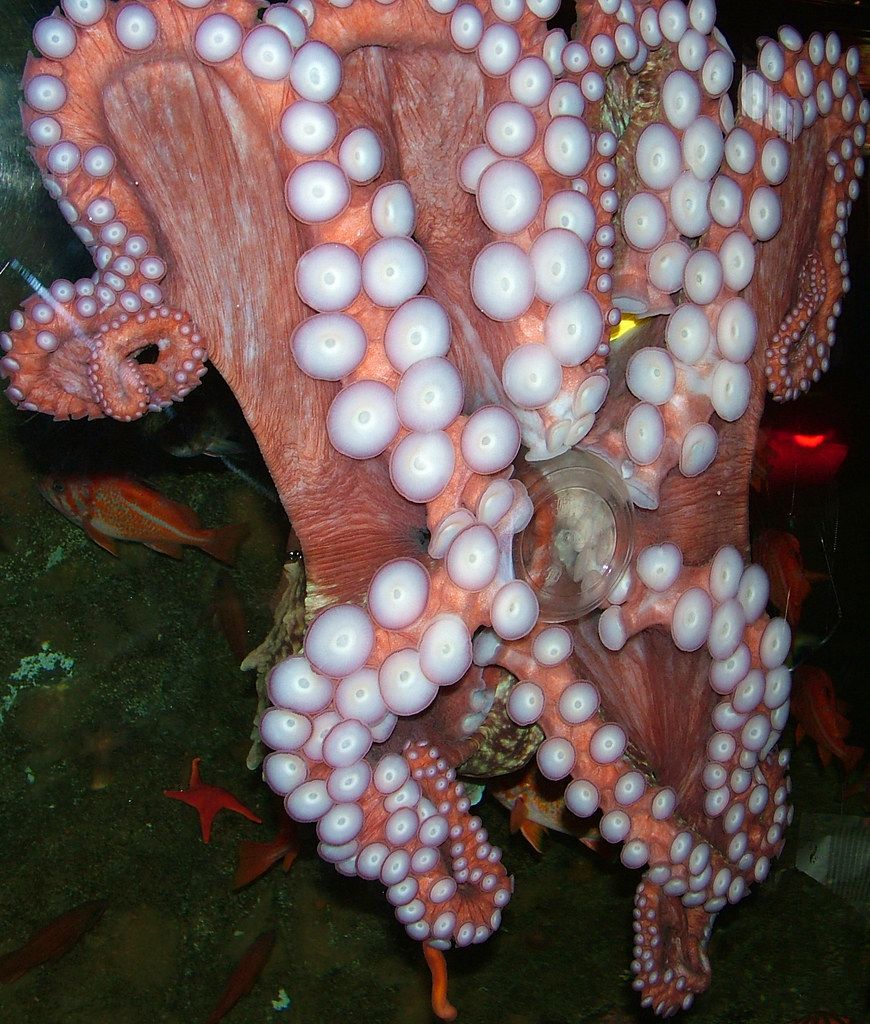
- FACT #1 An octopus has three hearts and blue blood. Two hearts pump blood through the gills, one serves the rest of the body — and the copper-based pigment in its blood turns it blue instead of red. The main heart actually stops beating when the octopus swims, which is one reason they prefer to crawl.
- FACT #2 Most of an octopus's neurons aren't in its head. Roughly two-thirds are spread through its eight arms, so each arm can taste, touch, and problem-solve semi-independently. (Frank says: imagine your left arm having opinions.)
- FACT #3 The peacock mantis shrimp throws one of the fastest punches in nature — its club-shaped limb accelerates so violently that the water around the strike briefly vaporizes into a collapsing bubble, delivering a second mini-blow. Aquariums have learned to keep them away from glass they're fond of.
- FACT #4 Sea otters sometimes hold paws while sleeping, and wrap themselves in kelp, so they don't drift apart on the current. It is exactly as practical as it is adorable.
- FACT #5 The Greenland shark may be the longest-lived vertebrate on Earth. A 2016 study that dated proteins in the sharks' eye lenses estimated some individuals were well over 270 years old — and one large female may have been close to 400. (Science, 2016)
- FACT #6 The so-called "immortal jellyfish," Turritopsis dohrnii, can reverse its own life cycle: when injured or starving, the adult can revert to its juvenile polyp stage and start growing up all over again.
- FACT #7 Among seahorses, it's the father who gets pregnant. The female deposits her eggs in the male's brood pouch, and he carries them until he gives birth to the tiny fry.
- FACT #8 The blue whale is the largest animal known to have ever lived — bigger than any dinosaur we've found. Its heart alone can weigh around 400 pounds. (Frank says: and you complain about carrying groceries.)
- FACT #9 Every clownfish is born male. They live in strict pecking orders, and when the dominant female of a group dies, the top-ranking male changes sex and takes her place. The movies skipped that part.
- FACT #10 An electric eel can discharge a jolt of several hundred volts — more than enough to stun prey and to make researchers very careful with their nets.
- FACT #11 Sharks are older than trees. Sharks have prowled the oceans for roughly 450 million years, while the earliest known trees appeared tens of millions of years later.
- FACT #12 Horseshoe crab blood is baby blue and medically precious: it clots in the presence of certain bacterial toxins, so for decades it has been used to test that vaccines and medical equipment are contamination-free.
Feathered Friends
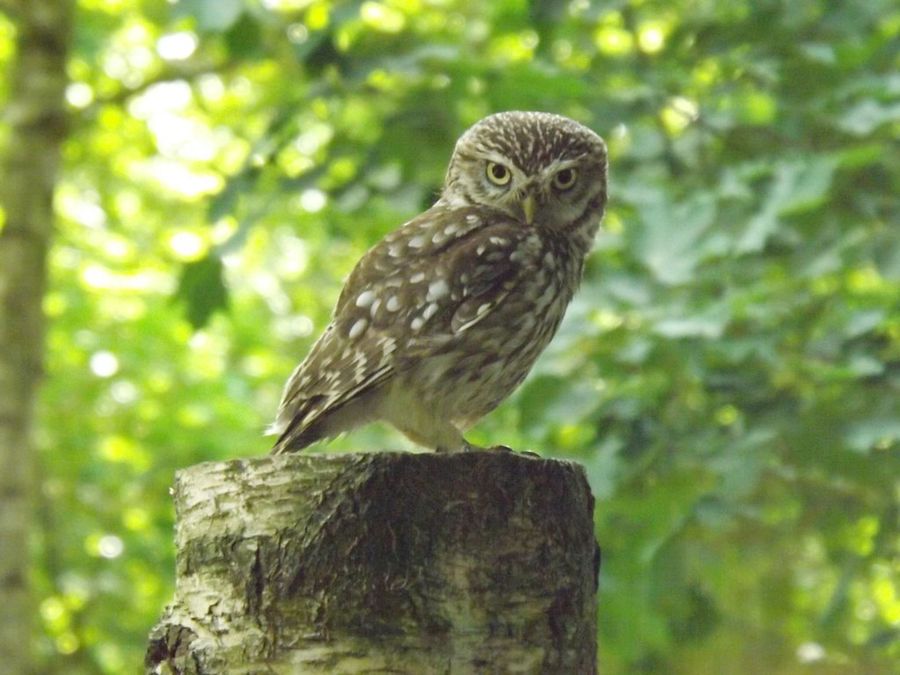
- FACT #13 Owls can't move their eyes. Their eyes are long tubes fixed in the skull — so instead, an owl can swivel its head about 270 degrees, thanks to extra neck vertebrae and specially routed blood vessels.
- FACT #14 Owl flight is nearly silent. Comb-like serrations on the leading edge of their wing feathers break up the air and hush the "whoosh" — a trick engineers have studied to design quieter fan blades.
- FACT #15 The Arctic tern commutes from the Arctic to the Antarctic and back every single year. Tracking studies have clocked round trips of more than 40,000 miles — the longest known migration of any animal.
- FACT #16 Hummingbirds are the only birds that can truly fly backwards, and their hearts can beat more than a thousand times a minute during flight.
- FACT #17 Emperor penguins are world-class divers: they've been recorded plunging more than 1,500 feet deep and holding their breath for over 20 minutes while hunting.
- FACT #18 Crows recognize individual human faces — and hold grudges. Researchers at the University of Washington who trapped crows while wearing a particular mask found the birds scolding that mask for years afterward, and teaching their friends to do the same.
- FACT #19 The wandering albatross has the largest wingspan of any living bird — over ten feet in big individuals — and can glide for hours over the open ocean barely flapping at all.
- FACT #20 Flamingos aren't born pink. Chicks hatch gray, and the famous color comes from pigments in the shrimp and algae they eat. Change the diet, and the pink fades.
- FACT #21 An ostrich's eye is bigger than its brain. Each eye is about two inches across — the largest of any land animal. (Frank says: no comment. The ostrich knows what it did.)
- FACT #22 The kiwi lays one of the largest eggs relative to body size of any bird — a single egg can amount to roughly a fifth of the mother's weight.
- FACT #23 Australia's superb lyrebird is nature's tape recorder: it convincingly mimics other birds and has been documented imitating camera shutters, car alarms, and chainsaws.
"A wombat's droppings are cube-shaped — the only animal known to produce them. Its intestine has stretchy and stiff zones that press the material into neat blocks, which handily don't roll off the rocks wombats use as message boards."
Frank says: nature invented the filing cabinet before we did.
✉️ Yes, Frank — Send Me the Free Weekly Facts!
Join the readers who win every trivia night.
One email every Friday. No spam, no nonsense, unsubscribe whenever you like. Frank's word is good.
Mammals Behaving Oddly
- FACT #24 Wombats produce cube-shaped droppings — see the plaque above. It bears repeating, and Frank will repeat it at any dinner party that will have him.
- FACT #25 A giraffe's neck contains the same number of vertebrae as yours: seven. Each of the giraffe's is simply enormous — up to ten inches long.
- FACT #26 Bats are the only mammals capable of true powered flight. Flying squirrels merely glide; bats actually earn the ticket.
- FACT #27 The platypus lays eggs, the males carry venomous spurs on their hind legs, and the whole animal has no true stomach — food passes from gullet to intestine. When the first specimen reached Europe, scientists suspected a hoax. (Frank sympathizes with those scientists.)
- FACT #28 Elephants can't jump. An adult elephant's legs are built like load-bearing columns, and at several tons, all four feet stay respectfully on the ground.
- FACT #29 Sloths visit the bathroom about once a week — and they climb all the way down from their tree to do it, one of the most dangerous errands in a sloth's calendar.
- FACT #30 A polar bear's skin is black, and its fur isn't truly white — the hairs are hollow and translucent, scattering light to look white against the snow.
- FACT #31 Dolphins sleep with one half of their brain at a time, keeping one eye open, so they can keep surfacing to breathe. It's called unihemispheric sleep, and Frank envies it on busy weeks.
- FACT #32 Cheetahs can't roar — they purr, chirp, and even meow. What they can do is sprint: a cheetah named Sarah at the Cincinnati Zoo was clocked at over 60 miles per hour.
- FACT #33 Horses cannot vomit. A powerful one-way valve at the entrance to the stomach means food generally goes in and only in — which is why colic is such serious business for a horse.
- FACT #34 Naked mole rats shrug off conditions that would finish most mammals: in one laboratory study they survived a full 18 minutes with no oxygen at all by switching their metabolism to run on fructose, plant-style. (Science, 2017)
- FACT #35 Cows appear to have best friends. Research measuring heart rates and stress hormones found cattle were measurably calmer when penned with a preferred companion than with a stranger.
Tiny Titans
- FACT #36 Tardigrades — "water bears" smaller than a millimeter — have survived direct exposure to the vacuum and radiation of open space, in a 2007 European experiment that flew them into orbit and brought some home alive.
- FACT #37 Ants routinely carry objects many times their own body weight, thanks to the mechanics of being small: muscle strength scales down far more slowly than weight does.
- FACT #38 Honeybees tell each other where the flowers are by dancing. The "waggle dance" encodes both direction and distance to the food, and decoding it helped win Karl von Frisch a Nobel Prize in 1973.
- FACT #39 A single worker honeybee produces only about one-twelfth of a teaspoon of honey in her entire lifetime, by beekeepers' common reckoning. Every jar is a stadium's worth of tiny careers. (Frank tips his hat before every slice of toast.)
- FACT #40 Dragonflies may be the deadliest hunters on Earth by success rate: studies have found they capture the prey they target more than 90 percent of the time. Lions should take notes.
- FACT #41 Butterflies taste with their feet. Sensors on their legs let a female sample a leaf the moment she lands, to check whether it's the right plant for her eggs.
- FACT #42 The axolotl, a permanently juvenile Mexican salamander, can regrow entire lost limbs — and repair its spinal cord, and parts of its heart and brain — without a scar.
- FACT #43 Fleas are champion jumpers, leaping many dozens of times their own body length in a single bound, powered by a spring-loaded pad of elastic protein in their legs.
That's the animal shelf — for now. Frank files new specimens most weeks, and the best ones go out first in Frank's Five. Next stop: the Science Facts shelf »
No animals were exaggerated in the making of this page. ★